
Organizations are like automobiles. They don’t run themselves, except downhill. They need people to make them work. And not just any people, but the right people. The effectiveness of an organization’s employees – particularly individuals in leadership positions – determines how the organizational “machine” will perform. The effectiveness of an organization’s employees determines how the organizational “machine” will perform. Character is a form of memory.The Diagnostic and Statistical Manual of Mental Disorders (DSM-IV-Tr), published by the American Psychiatric Association, which lists ten personality types.The hand that rocks the cradle rules the world.” All of us are nothing more than a developmental outcome of our early (and later) environment modified by our genetic endowment
Right-brain communication is what we all first learned; it’s what we used as very small children to connect with our parents, communicating through (and being responded to with) very subtle signals. Unfortunately, in the process of growing up, we unlearned many of our right-brain skills. As a result, for most of us this form of thinking and communicating has atrophied.(for an overview of different styles of thinking.)
The word emotion comes from the Latin word motere, which means “to move,” and emotion certainly does move people in various ways, in the workplace just as in all other spheres of life. Many organizations have come to realize that an ounce of emotion can be more effective than a ton of facts.
The three primary components of emotional intelligence are:
The higher up a person is in an organization, the more important emotional intelligence becomes (and the less important technical skills become). Although people usually get hired initially because of a specific technical skill set, once they’ve climbed the ladder to more senior levels in the organization it’s emotional intelligence that makes the difference between a successful career and career stagnation.It means being realistic about self and others, accepting humanity with all its varied dimensions, and using emotions appropriately. And the rewards for emotional intelligence are great: having a high EQ leads to more appropriate decision making, contributes to greater realism in interactions with others, and prevents disappointment in relationships.Interacting with a dead fish is just as unpleasant as dealing with a raging tiger. Our expectations of others’ responses in the present are colored by our feelings, attitudes, and behaviors toward significant people from the past.
Many executives don’t pay much attention to their inner world. In fact, they keep themselves busy (with the help of the “manic defense”) just to make sure they don’t have time to reflect. It’s rarely a conscious avoidance, but it’s an avoidance nonetheless. They run faster and faster, giving very little thought to what they’re running for or where they’re running to….
many executives don’t pay much attention to their inner world
We all need to be the architects of our own fate, the authors of our own script. If we turn that scripting over to others, we’re not really living, we’re just playing a part. How much better it would be to own our own lives. And we can – if we’re willing to open ourselves to the possibilities of change. To change, however, you have to stop at times to reflect on your life.
The mussel syndrome is very common in organizational settings. Leaders who surround himself with yea-sayers, people who told him only what he wanted to hear is called mussel syndrome. The mussel syndrome can prevent leaders from making the paradigm shift that today’s world requires
What do you do when you arrive at your office? What do you find important? What do you spend your time on as an executive? What elusive leadership qualities manifest themselves in your daily work at the office. CONFLICT AVOIDANCE, THE TYRANNIZATION OF SUBORDINATES, MANIC BEHAVIOR are factors for failure in leadership
NOTE:- leaders shouldn’t look in the mirror; they should look out the window
The popularity of Dilbert is an indication of the extent to which people in today’s marketplace experience career alienation and cynicism. Because in so many companies people recognize a disconnection between organizational rhetoric and organizational reality, they hear slogans such as “People are our greatest asset,”. Like Dilbert, people the world over confront bureaucratic absurdity and managerial idiocy in their daily struggle to survive life in a cubicle (whether real or metaphorical). Treated like cogs in a machine by organizations whose annual reports speak with pride of “respecting the individual” – organizations that take their “human capital” for granted, rhetoric notwithstanding – they lose interest in their work.
THE NOBEL PRIZE COMPLEX
Some executives become paralyzed when they reach the top. After striving for years for a particular position (such as CEO), they fall apart once they achieve it. Because they fear the envy of others – a state that’s been described as the “Nobel Prize complex
A Spanish saying echoes this linkage between ineffective leadership and decay: “Fish start to smell at the head.” In organizations where power is highly concentrated – where the decision-making authority is centralized in the hands of either a top executive or a small, homogeneous dominant coalition – the person–organization interface is so close that any rot at the head quickly spreads throughout. In organizations where power is broadly distributed, by the same token, culture and strategies are influenced by many executives, and thus the relationship between leadership style and organizational pathology is more tenuous.
Strategy and organizational structure can be influenced strongly by the personality of the leader
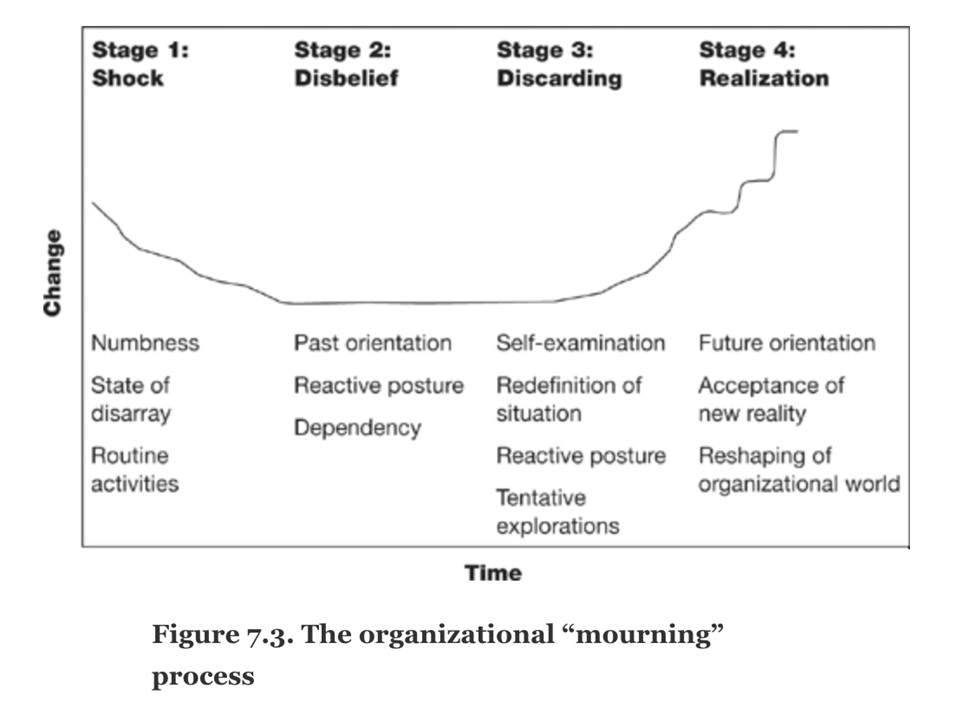
The process of Change
The natural human resistance to change has a parallel in the domain of organizations. While the marketplace changes daily – advances in technology competing with improvements in communication – many organizations prefer to hunker down in the status quo. Yet in this age of discontinuity, the companies that last through the coming decades will be those that can respond effectively to the changing demands of their environment. How, then, can corporate leaders proactively drive the process of organizational change? How can they be most effective as change agents? How can they apply what’s known about the dynamics of personal transformation to an organizational setting? These questions are critical now that change has become the rule rather than the exception for those seeking corporate survival and success.
In other words, it’s easier to start with a new crew (with a new mindset) than to transform the one you have. Many people have the will but not the skill to change.
THE FIVE C’S OF CHANGE
Let’s look now at the five C’s of change – necessary components of any individual or organizational change process. They are concern, confrontation, clarification, crystalization, and change.
There are three main approaches: restructuring (getting smaller), reengineering (getting better), and reinventing the corporation (getting smarter)
Organizational culture provides rules for behavior
The world is divided into people who do things and people who get the credit. Try, if you can, to belong to the first class. There’s far less competition.
Most effective leaders possess clusters of competencies in three areas:
Vision without action is a hallucination. Likewise, managers can’t take the steps they’re so good at unless they know what direction to go. Passion and pride is what drives leaders too
A wit once said that there are three kinds of people in this world: those who make things happen, those who see things happen, and those who wonder what’s happened.
Another important factor in the development of leadership is mentoring. People learn the organizational “ropes” from mentors. Mentors help those under their wing understand the political systems in an organization, for example, and they often recognize serious mistakes in the offing and prevent them. Doing a good job here is like wetting your pants in a dark suit. It gives you a warm feeling but nobody notices! The effective global leader in the digital age is able to inspire trust in subordinates. Authentizotic organizations facilitate innovation because of their people orientation. They provide the “AIR” necessary to forward-looking innovation:
A | They give people a considerable amount of Autonomy to encourage creativity. |
I | They encourage Interaction between different parts of the organization to create synergy. |
R | They Recognize individual contributions to foster empowerment. |
Now I’d like to introduce the four H’s of effective leadership: hope, humanity, humility, and humor:
Thanks for reading……….